
The Critical Role of Modular Cleanrooms in Pharmaceutical Production
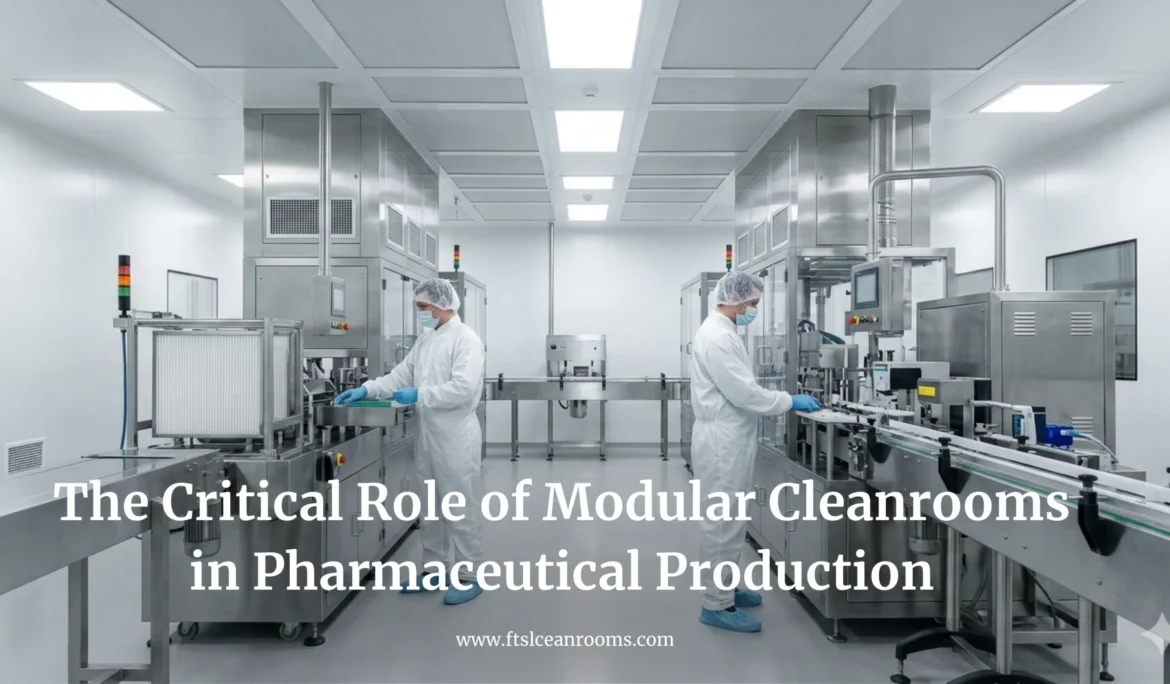
In the pharmaceutical industry, maintaining strict control over manufacturing environments is essential to producing safe, high-quality, and effective healthcare products. Modular cleanrooms specially engineered environments designed to prevent contamination during drug production play a vital role in achieving this objective.
Traditionally, cleanrooms were constructed using stick-built methods. However, as regulations become more stringent and market demands continue to evolve, modular cleanrooms have emerged as the preferred solution for modern pharmaceutical manufacturing. In fact, industry forecasts for early 2025 indicate that modular and prefabricated cleanroom systems will be among the most significant trends in cleanroom construction particularly in fast-growing sectors such as nanotechnology and gene therapy.
Whether you operate in biopharmaceuticals, biotechnology, medical device manufacturing, or related industries, and are planning to establish a cleanroom facility, FTS Cleanrooms strongly recommends considering a modular approach. Modular cleanrooms not only enhance production efficiency but also significantly reduce project timelines and optimize capital expenditure (CAPEX).
If you are new to cleanroom technology or modular systems in high-containment manufacturing, this guide will help you understand why prefabricated solutions are increasingly becoming the smart choice.
Understanding Cleanroom Classifications
Cleanrooms are classified based on the number of airborne particles permitted per cubic meter of air. This internationally recognized classification system, defined by ISO standards, ranges from ISO 1 (the highest level of cleanliness) to ISO 9.
Different pharmaceutical processes require different cleanliness levels to ensure product safety and efficacy. Selecting the appropriate cleanroom classification is therefore a critical step in facility planning.
Airflow design plays a crucial role in maintaining cleanliness. Higher-class cleanrooms typically utilize laminar airflow systems to deliver uniform, particle-free air distribution. Lower-class cleanrooms may operate with turbulent airflow systems, which still effectively manage contamination within acceptable limits.
Why Certification and Compliance Matter
Pharmaceutical manufacturing facilities must comply with strict regulatory requirements established by authorities such as the US FDA and the European Medicines Agency (EMA). Cleanroom certification is essential to demonstrate that the environment meets defined cleanliness and operational standards.
Certification involves detailed testing, including particle count verification, airflow visualization, filter integrity testing, and air velocity measurements. Beyond initial certification, periodic audits and recertifications are required to ensure the facility consistently maintains compliance and operational integrity.
Maintaining certification not only ensures regulatory approval but also reinforces product quality, safety, and market credibility.
The Benefits of Modular Cleanrooms in Biopharma Manufacturing
Streamlined Construction Process
Traditional cleanroom construction can be time-intensive and resource-heavy. Modular cleanrooms simplify the process through pre-engineered components manufactured in controlled environments and assembled efficiently on-site.
This significantly reduces installation time, limits on-site labour, and minimizes disruption to ongoing operations. Additionally, modular systems reduce material waste and site preparation requirements, making them a cost-effective solution.
Another major advantage is flexibility. Modular cleanrooms can be relocated, expanded, or repurposed as operational needs evolve. Even companies planning permanent facilities often utilize modular systems to pilot new production processes before committing to large-scale infrastructure investments.
Adaptable Design for Evolving Needs
One of the standout advantages of modular cleanrooms is adaptability. Unlike conventional construction, which can be expensive and complex to modify, modular systems allow reconfiguration with minimal downtime.
Whether increasing capacity, integrating new equipment, or upgrading systems, modular cleanrooms can be efficiently adjusted to meet changing production demands.
With FTS Cleanrooms as your partner, modular systems can also be customized to incorporate specialized equipment such as isolators, biosafety cabinets, and other critical process tools ensuring the environment aligns perfectly with your operational requirements.
Precision Environmental Control
Biopharmaceutical production demands exact control over environmental parameters including airflow, temperature, humidity, pressure differentials, and particulate concentration.
Modular cleanrooms designed by FTS Cleanrooms integrate advanced HVAC and air handling systems engineered to meet precise operational specifications. These systems ensure consistent environmental conditions that are essential for product stability, sterility, and testing reliability.
High-performance filtration systems including HEPA and ULPA filters — capture particles as small as 0.3 microns, maintaining stringent contamination control standards. Efficient air circulation design also supports energy optimization, reducing unnecessary air recirculation and contributing to sustainable facility operations.
Ongoing Monitoring and Maintenance
Cleanroom compliance is not a one-time achievement it requires continuous monitoring and verification.
Routine particle count assessments, airflow checks, and filter integrity testing are critical to maintaining classification standards. Modern modular cleanrooms often incorporate automated monitoring systems that provide real-time data on environmental performance, allowing immediate corrective action if deviations occur.
Many FTS Cleanrooms installations include integrated quality assurance and monitoring systems to safeguard operational consistency at every stage of production.
The Role of Your Modular Cleanroom Engineering Partner
Successful cleanroom implementation depends heavily on expert project management and engineering precision.
An experienced process engineering partner ensures every component from wall systems and HVAC integration to insulation, fire safety, and waste management complies with regulatory standards while optimizing efficiency.
Validation is a critical and ongoing process to confirm that the cleanroom consistently performs according to its designated ISO classification. This includes airflow verification, filter leak testing, and particle monitoring.
Compliance with Good Manufacturing Practices (GMP) ensures pharmaceutical products are manufactured in controlled and sterile conditions. Collaboration between manufacturers and engineering partners also supports staff training, contamination control procedures, and risk mitigation reducing the likelihood of safety incidents or costly product recalls.
Continuous validation and compliance management keep facilities aligned with evolving regulatory expectations.
Achieve International Standards with FTS Cleanrooms
At FTS Cleanrooms, we specialize in delivering modular cleanroom solutions tailored to the specific requirements of the biopharmaceutical industry.
Our expertise spans efficient cleanroom design, advanced HVAC systems, fire suppression integration, double insulation, weather-resistant structures, and precision environmental controls. We develop fully customizable environments that support compliance with stringent global regulations.
Our experienced team is dedicated to delivering high-quality, cost-effective, and performance-driven cleanroom solutions. From concept design and engineering to validation and final handover, FTS Cleanrooms supports your project at every stage.
If you are planning your next cleanroom facility or upgrading an existing one, connect with FTS Cleanrooms today. Let us help you maintain the highest standards in pharmaceutical manufacturing.