Contamination Control Strategy for Advanced Therapy Medicinal Products (ATMP) Cleanrooms
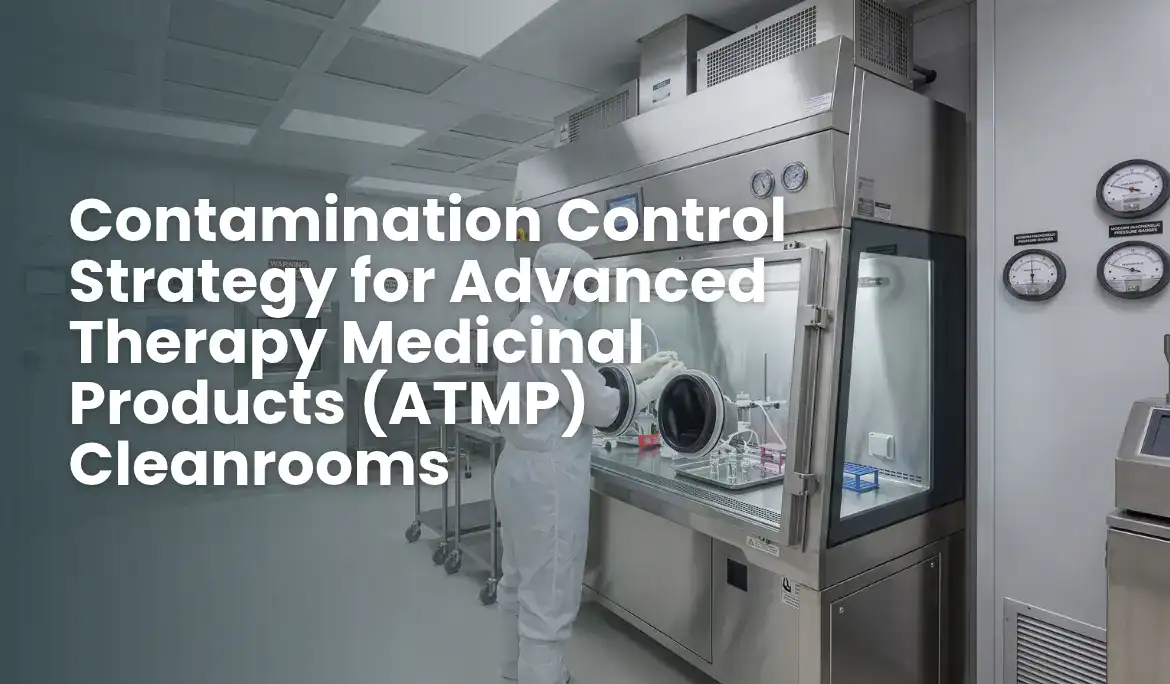
In Advanced Therapy Medicinal Products (ATMP) manufacturing, even a small contamination event can compromise product quality, patient safety, and the success of a treatment. As these therapies often involve living cells, tissues, or gene-modified materials, maintaining a controlled manufacturing environment requires more than conventional cleanroom practices. That is why a contamination control strategy for ATMP cleanrooms has to be settled while the facility is still on paper. It is also the strongest argument for turnkey cleanroom solutions, where the design, build, and qualification all follow the same document.
The Gulf is building this capacity now. Abu Dhabi Stem Cells Centre started making CAR-T cells locally in 2021. Saudi Arabia’s SFDA gave ATMPs their own annex in May 2026. Anyone planning a facility in the region will face the same questions from their regulator.
This guide covers what makes ATMP cleanrooms different, what a Contamination Control Strategy (CCS) must contain, and how to validate cleaning and transfer points.
What Does ISO 14644-4:2022 Expect From Cleanroom Design?
There are three factors that separate an ATMP cleanroom from a conventional sterile facility. The product is made of living cells, the starting material is biological, and much of the processing is manual.
Many conventional sterile products can be passed through a sterilising filter or terminally sterilised. Neither option exists for living cells. EU GMP Part IV, section 9.39, states that most ATMPs cannot be terminally sterilised, so production must be aseptic throughout.
Biological starting materials such as apheresis products or tissue can carry microbial contamination from the donor or from collection. They cannot be sterilised without destroying the cells. Part IV, section 7.11, allows antimicrobials during procurement but states that they do not replace aseptic manufacturing.
Most steps are open manipulations in a biosafety cabinet. Part IV, section 9.46, requires a Grade A critical area with a Grade B background for open aseptic preparation. Section 9.41 accepts a Grade D background only for closed systems and isolators.
Short shelf life changes release testing as well. Part IV sections 2.39 to 2.41 accept that a compendial sterility result may not be available before release. The manufacturer must then adapt its sterility assurance strategy. Where results are pending at release, section 2.41 requires mitigation measures, including informing the treating physician. Therefore, the sterility assurance depends on the combined effect of facility design, aseptic procedures, process controls and testing
What Should a Contamination Control Strategy (CCS) Actually Cover?
A contamination control strategy for ATMP cleanrooms is the document that ties every contamination control in the facility together. Section 2.5 of EU GMP Annex 1 lists sixteen elements to consider. These include facility and process design, personnel, utilities, raw material controls, cleaning and disinfection, monitoring and CAPA.
In the EU, ATMPs are inspected against Part IV, a 2017 guideline that predates the CCS. EMA published a concept paper in May 2025 to align Part IV with Annex 1. A draft was planned for September 2026. In October 2026, EMA still lists only the concept paper. Swissmedic has already stated in writing that it expects ATMP manufacturers to develop and implement a CCS.
An inspector will expect your CCS to answer these questions:
- Which steps are open and which are closed, and what grade sits behind each.
- The reasoning for selecting a biosafety cabinet, a restricted access barrier system (RABS), or an isolator. Annex 1 expects any alternative to RABS or isolators to be justified.
- How patients, batches and vectors are kept apart, including in shared incubators and fridges.
- The cleaning and disinfection programme, with proof that it works on your surfaces.
The cleanroom provider can coordinate design, manufacturing, installation and validation through one team, helping maintain consistency across each stage and streamline the documentation needed to demonstrate contamination control.
How Should Critical Cleaning and Disinfection Be Validated in ATMP Cleanrooms?
Three separate activities are involved. Disinfectant efficacy testing shows in the laboratory that each kills the expected organisms on the facility’s surfaces. Validation of the cleaning step shows that it removes the soil and chemical residue. Environmental monitoring tracks the state of the room but does not prove on its own that the programme works.
Annex 1 sets the baseline in sections 4.33 to 4.35. More than one type of disinfectant must be used, and disinfection should include the periodic use of a sporicidal agent. Disinfectants and detergents used in Grade A and B must be sterile before use. Section 4.34 requires the disinfectant process to be validated for the way agents are used and the surface materials used.
Most laboratory studies follow EN 13697, EN 16615, or USP <1072>. The chapter on USP sets a 3-log reduction for vegetative bacteria and a 2-log reduction for bacterial spores. A lab result is only effective if the test was run according to the way the room is used.
The following factors are important in this case:
- Run the tests on samples of the wall coating, floor, glass, and gloves that will be in the room. One supplier’s published tests found disinfectants that passed on stainless steel and failed on PVC flooring, glass, and aluminium
- Challenge the agents with standard strains and with isolates recovered from the facility’s own monitoring.
- Validate the wet contact time operators can achieve in practice, not the figure on the label.
In the case of living cells, residue control is most important. Annex 1, section 4.33, requires cleaning before disinfection, since soil reduces the effectiveness of disinfectant. It also requires the programme to remove disinfectant residue. There is a possibility of residue damaging cell viability, and an aseptic cell process does not include a later step that can avoid it. Therefore, Annex 1, section 4.22, asks for proof that the agents used do not harm the product.
Part IV’s Section 4.15 requires a procedure for cleaning and decontamination of validated effectiveness before the next batch where suites are shared.
Sporicides degrade poor coatings and sealants over repeated cycles. Annex 1, section 4.7, requires materials that withstand repeated cleaning, disinfection, and sporicide use. Specify modular cleanroom panels with a finish backed by chemical compatibility data.
Cleanroom validation and disinfection validation answer different questions:
- ISO 14644-1 classification counts airborne particles and confirms that the room meets its grade.
- Disinfection validation confirms that the cleaning agents and methods work as intended on the surfaces in that room.
Review your ATMP layout against the CCS before construction starts
Airlock sizes, pressure cascades and wall finishes cost little to change on a drawing and a lot on site. FTS Cleanrooms has more than 120 engineers and design professionals who take projects from concept through to validation. Book a consultation, and we will go through your facility requirements and flag design issues early.
How Do Material and Personnel Transfer Points Affect Contamination Risk?
Annex 1, section 4.10, describes the transfer of equipment and materials as one of the potential sources of contamination. ATMP facilities face this risk more often than conventional plants. Every patient batch needs its own consumables and media. The starting material arrives in packaging that has passed through a clinic and a courier.
Alexis Stachowski, Associate Director of QA Microbiology at Regeneron, set out the practical problems in March 2026. Airlocks designed for occasional transfers cannot handle ATMP volumes. Items crowd the staging area and contact times fall as technique drifts. She also cautioned against relying on 70% IPA alone and described a sporicidal disinfectant validation step as important.
Annex 1, sections 4.11 to 4.13, set clear rules for a material transfer airlock:
- Items enter Grade A and B in one direction, with a separate route out or separation by time.
- Only items on an approved list may pass through.
- Doors into Grade A and B are interlocked. Anything that cannot be sterilised on entry needs a validated disinfection and transfer process.
The airlock itself needs space to stage a kit, wipe it down and hold it wet for the contact time. Patient material needs a separate receipt route, and waste needs an exit that does not cross incoming kits.
An operator who moves from one patient’s batch to the next is also a transfer route. Part IV, section 3.29, therefore requires movement restrictions and disinfection between rooms.
What Common Contamination Control Mistakes Put ATMP Facilities at Risk?
Most contamination control problems in ATMP facilities begin at the design stage. They usually come from treating an ATMP suite as a scaled-down version of a conventional sterile plant. The ones below recur most often:
- A late CCS: The strategy is written after handover, when zoning and airlock sizes can no longer change.
- Grade C for open work: A research lab with biosafety cabinets is presented as GMP. Part IV, section 2.50, allows Grade A in a Grade C background only for very early phase investigational trials. Three conditions apply together, namely a documented risk assessment, a life-threatening condition with no alternative, and the competent authority’s agreement. It is not a general permission.
- Poor cleanability: Ledges, exposed pipework and failing sealant leave surfaces that cannot be cleaned. Flush modular cleanroom panels help, but every joint and equipment interface has to be detailed and sealed as well.
- Equipment outside the programme: Incubators, fridges and centrifuges are left out of cleaning and monitoring. Part IV, section 4.46, expects monitoring to cover isolators and biosafety cabinets, and shared incubators deserve the same.
- Results read as sterility: Clean results are treated as proof of sterility. Annex 1 states that monitoring alone does not give that assurance.
Talk to FTS Cleanrooms about your ATMP facility
A contamination control strategy for ATMP cleanrooms depends on design decisions made long before the first panel is installed. FTS delivers turnkey cleanroom solutions across the UAE, Saudi Arabia, Oman, Qatar, Bahrain, Kuwait and Iraq. One team handles design, manufacturing, installation, commissioning, and cleanroom validation, and our panels and doors are made in-house. Reach out to us today to learn more.
FAQs
A Contamination control strategy for ATMP cleanrooms is a facility-wide plan. It identifies each contamination risk to the product and sets out the controls that manage it. Annex 1 has been the expected standard for sterile medicinal products in the EU since August 2023. Part IV, the EU guideline for ATMPs, is being revised to match Annex 1. SFDA’s GMP guide includes Annex 1 and, since May 2026, Annex 2A for ATMPs. Treat a CCS as the standard for any new ATMP facility.
Routine cleaning is the scheduled cleaning of floors, walls, and general surfaces in every grade. Critical cleaning covers the surfaces nearest the product, such as cabinet and isolator interiors and transfer hatches. Its frequency and method follow the facility’s risk assessment and approved procedures.
Annex 1, section 4.33, expects more than one type of disinfectant and the periodic use of a sporicidal agent. Selection depends on efficacy against the organisms found on site, compatibility with the installed surfaces, intended use, and validation results. Section 4.34 requires the disinfection process to be validated. EN 13697, EN 16615, and USP <1072> are the standard references for efficacy testing.
Biosafety cabinets in a Grade B room remain acceptable for open processing under Part IV, section 9.46. Annex 1, section 4.3, expects any alternative to RABS or isolators to be justified. Section 4.20 sets the background grades. RABS needs at least Grade B, and an open isolator at least Grade C. A closed isolator needs at least Grade D, which ISPE authors note lowers gowning, monitoring, cleaning, and energy costs.
A contamination event normally means the batch cannot be released. For an autologous product, that batch was one patient’s treatment. Part IV, section 11.5, allows an out-of-specification batch to be administered only in exceptional circumstances, at the treating physician’s request. A UK study of 981 lymphoma patients approved for CAR-T recorded 38 manufacturing failures. Those failures came from cell quality rather than contamination, but they show what any lost batch means for the patient.