Aseptic Fill-Finish Cleanroom Design: Choosing Between Isolators and RABS
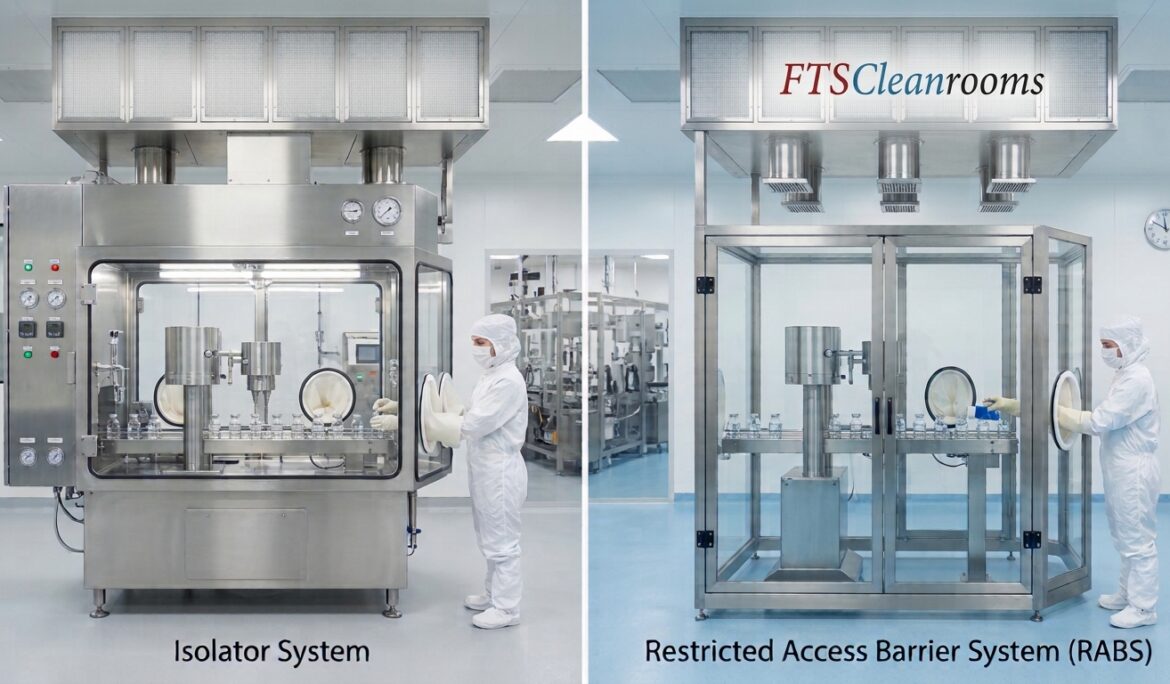
A sterile vial is filled in seconds. The decisions that protect that moment are made months earlier, on a layout drawing, when the project team decides what will separate the open product from the people operating the line.
That choice — an isolator or a restricted access barrier system (RABS) — shapes almost everything around it: the cleanroom grade of the surrounding room, the size of the HVAC plant, gowning and airlock arrangements, transfer routes, decontamination and the validation programme. Get it right early, and the aseptic fill-finish cleanroom is built around a coherent contamination control strategy. Get it wrong, and the facility spends its life compensating.
This matters across the GCC right now. Saudi Arabia has seen MS Pharma open a $50 million biologics plant with SFDA GMP approval (August 2025), Julphar sign for an integrated facility of up to SAR 300 million with MODON (December 2025), and a Lifera–Resilience joint venture proposed in Riyadh for aseptic filling of vaccines and biologics. In the UAE, LIFEPharma announced a proposed Dh700 million platform at KEZAD in May 2026, including a vaccine fill-finish facility. Each of these projects must make the barrier decision described below.
What Is an Aseptic Fill-Finish Cleanroom?
An aseptic fill-finish cleanroom is the controlled environment in which sterile product — typically injectables, vaccines, monoclonal antibodies or peptides — is filled into its final container and sealed without terminal sterilisation. Because the product cannot be sterilised after filling, the environment and the barrier around the open product carry much of the sterility assurance.
In the EU GMP framework, the critical zone where product is exposed is Grade A. EU GMP Annex 1 (2022) sets the Grade A limit for particles ≥0.5 µm at 3,520 per m³, both at rest and in operation, and gives a guidance value of 0.36–0.54 m/s for unidirectional airflow at the working position. What surrounds that Grade A zone depends largely on the barrier technology selected.
Why the Barrier Decision Drives the Whole Facility
Annex 1 does not require one specific technology. It states that RABS or isolators are beneficial in assuring required conditions, that their use should be considered in the contamination control strategy (CCS), and that any alternative approach should be justified. In practice, the barrier choice sets the background cleanroom grade — and the background grade drives cost, energy and operations.
| Barrier approach | Minimum background grade (EU GMP Annex 1, para 4.20) | Facility implications |
| RABS (aseptic processing) | Grade B | Larger Grade B suite, higher air volumes, sterile gowning for operators in the background room, more demanding airlocks and changing rooms. |
| Open isolator | Generally Grade C | Smaller high-grade footprint; isolator interior needs validated, automated bio-decontamination; mouse-hole or transfer design becomes critical. |
| Closed isolator | Grade D | Lowest background grade; transfers rely on aseptic connections (e.g., RTP/beta ports); highest equipment cost and engineering integration. |
| Conventional open Grade A (no barrier) | Grade B | Highest intervention risk; Annex 1 expects alternatives to RABS/isolators to be justified in the CCS. |
Note: Background grades are minimums. The final classification should come from the process risk assessment, product, container type and regulator expectations for the target markets.
Isolator vs RABS: How They Compare in Practice
Isolators
An isolator is a sealed enclosure with an internal Grade A environment, decontaminated by an automated cycle. Annex 1 expects the interior bio-decontamination to be automated, validated and controlled, and to include a sporicidal agent. Isolator glove integrity testing should be performed at minimum at the beginning and end of each batch.
- Strengths: strong separation of operators from product; lower background grade; reduced reliance on sterile gowning in the surrounding room.
- Watch-outs: higher capital cost, decontamination cycle time and its effect on changeovers, and less flexibility once a cycle is running.
RABS
A RABS provides a rigid barrier with glove ports around a Grade A zone with unidirectional airflow and first-air protection, inside a Grade B room. RABS gloves should be visually examined with each use and integrity-tested at periodic intervals. RABS can sometimes be integrated with existing filling equipment, which is one reason they are considered in retrofit projects.
- Strengths: often simpler to integrate with existing lines; faster format changeovers in some operations.
- Watch-outs: a larger Grade B background with higher HVAC energy demand, stricter gowning, and more weight on operator behaviour and intervention control.
Isolators do not automatically equal compliance
A May 2026 analysis in Pharmaceutical Online makes a useful point: an isolator is not a compliance shortcut. Well-designed active RABS can meet Annex 1, and isolator projects run into trouble through poorly designed material transfers, decontamination treated as a standard feature rather than a validated process, underestimated interventions and weak integration with the building. The barrier is one element of the CCS, not a substitute for it.
Key Cleanroom Design Considerations for a Fill-Finish Suite
- Zoning and grade cascade: map Grade A, the background grade and the supporting Grade C/D areas (component preparation, compounding, washing, capping) against personnel and material flows.
- Pressure regime: Annex 1 gives a guidance value of at least 10 Pa between adjacent rooms of different grades. Where potent or live biological material is handled, the cascade may need containment-led design, which should be agreed with the process owner and safety team.
- Airlocks and transfers: the final stage of an airlock should, at rest, match the grade of the room it serves. Plan separate routes for components, stoppers, waste and people, and design how materials enter the isolator or RABS.
- HVAC and filtration: air volumes are driven by the background grade, heat loads from the line and freeze-dryers, and recovery performance. Annex 1 gives a guidance clean-up time of less than 20 minutes.
- Airflow visualisation: Annex 1 expects airflow patterns to be visualised, at rest and in operation, to show there is no ingress into the Grade A zone. The room, barrier and equipment must be designed to pass this test.
- Equipment interfaces: filling machines, lyophilisers, capping and inspection need coordinated loading, utilities, service access and wall penetrations.
- Monitoring: particle and microbial monitoring points, pressure and temperature/RH sensors should be placed according to risk assessment and connected to an alarmable monitoring system.
- Finishes and cleanability: smooth, non-shedding, cleanable surfaces compatible with disinfectants and sporicidal agents used in the cleaning regime.
From Design to Delivery: A Practical Sequence
- Define the product and process. Product types, container formats, batch sizes, potency or biosafety, lyophilisation and target markets.
- Set the contamination control strategy. Decide the barrier concept and justify it within the CCS before the architecture is fixed.
- Develop the layout. Zoning, grade cascade, flows, airlocks, equipment positions and maintenance access.
- Engineer the building systems. HVAC, HEPA filtration, pressure control, utilities, monitoring and BMS/EMS integration.
- Coordinate with the equipment vendor. Isolator/RABS interfaces, transfer ports, decontamination utilities and FAT/SAT planning.
- Build and install. Cleanroom partitions, ceilings, doors, flooring and services to the approved design.
- Test, commission and qualify. Applicable classification testing, airflow visualisation, pressure and recovery tests, followed by qualification activities defined in the validation plan.
Common Mistakes When Planning a Fill-Finish Cleanroom
- Selecting the barrier after the room layout is fixed.
- Sizing the HVAC plant before heat loads from the filling line and lyophilisers are confirmed.
- Underestimating space for transfer, decontamination and waste routes.
- Treating the background grade as a cost-saving lever without assessing intervention risk.
- Leaving future capacity — a second line or format — out of the utility and HVAC design.
How FTS Cleanrooms Supports Sterile Manufacturing Projects
FTS Cleanrooms designs and delivers controlled environments for pharmaceutical, biotechnology, semiconductor, aerospace and research applications. For sterile and aseptic projects, the work starts with the process and the contamination control strategy, then translates them into a buildable facility.
Depending on the project scope, FTS can coordinate:
- Cleanroom engineering, zoning and layout development around the selected barrier technology.
- Cleanroom partitions, doors, ceilings and finishes suited to the cleaning regime.
- HVAC systems, HEPA filtration, pressure control and environmental monitoring.
- MEP coordination with filling, isolator or RABS equipment suppliers.
- Installation, testing and applicable validation support.
Each project needs its own process review, engineering criteria and validation plan. The right answer for a vaccine line differs from that for a peptide or mAb line.
The GCC Outlook for Sterile Manufacturing
Recent announcements show sterile injectables, vaccines and biologics moving up the agenda for regional manufacturers, with several projects still at the proposed or early stage. For owners in that position, the barrier decision and the cleanroom concept are best settled together, before the building is designed around assumptions.
Planning a sterile injectables, vaccine or biologics fill-finish facility?
Speak with FTS Cleanrooms before the layout is finalised.
Website: www.ftscleanrooms.com
Email: marketing@ftscleanrooms.com
FAQs
An isolator is a sealed enclosure decontaminated by an automated, validated cycle, so it can sit in a lower-grade room. A RABS is a rigid barrier with glove ports around a Grade A zone, but it is not fully sealed, so EU GMP Annex 1 expects it to sit in at least a Grade B background.
Under EU GMP Annex 1 (para 4.20), the background for an open isolator should generally be at least Grade C, and for a closed isolator at least Grade D. The final grade should be justified by the contamination control strategy.
No. Annex 1 says RABS or isolators are beneficial and should be considered in the contamination control strategy. Alternatives must be justified. A well-designed RABS can be compliant.
Annex 1 sets 3,520 particles per m³ at ≥0.5 µm for Grade A, both at rest and in operation.
Annex 1 gives a guidance value of 0.36–0.54 m/s for unidirectional airflow, with justification and verification required for the actual installation.
Annex 1 gives a guidance value of at least 10 Pa between adjacent rooms of different grades. Containment requirements may change the direction of the cascade in some areas.
It depends. Isolators usually cost more as equipment, but a lower background grade can reduce cleanroom area, air volumes and gowning costs. A lifecycle comparison for the specific product mix is needed.
Timelines vary with scope, equipment lead times and qualification requirements. Early agreement on the barrier concept and CCS helps avoid redesign later.