The Ultimate Guide to Cleanroom Validation Process
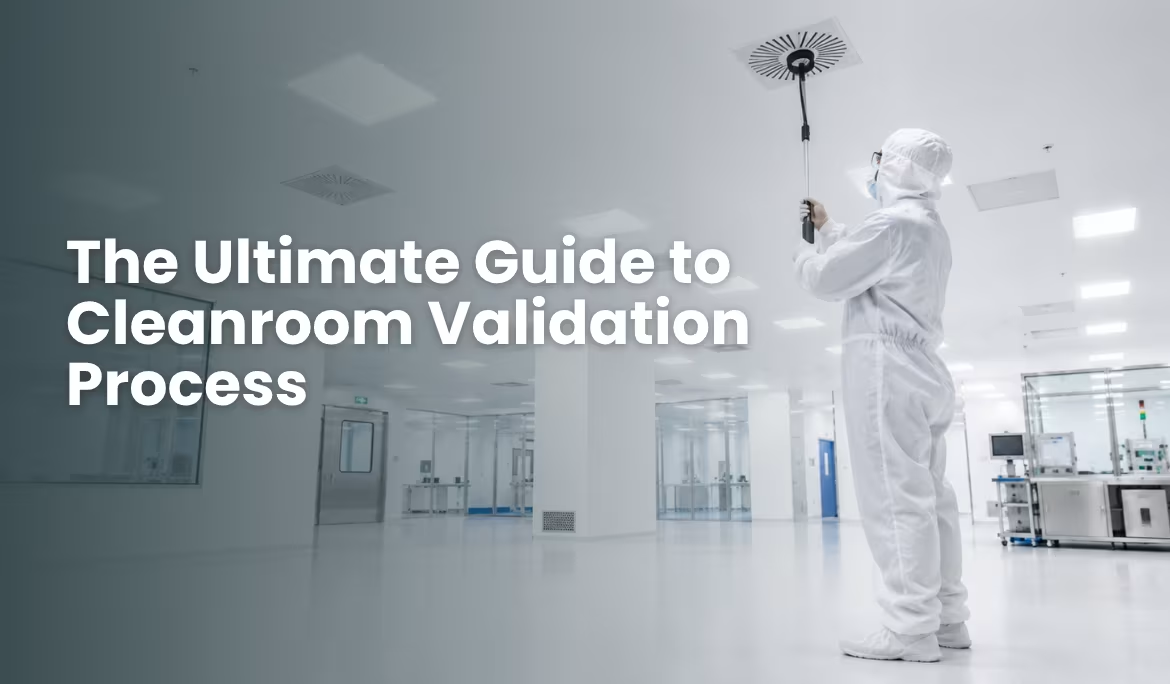
You can build a flawless cleanroom and still fail an audit. Panels sealed right, HVAC humming, particle counts looking clean to the eye. None of that means anything without validation. The cleanroom validation process shows that your room works as it should. It uses data and a format that auditors will accept. Skip it or rush it, and you’ve got a room that looks compliant but isn’t.
Here’s what the process actually involves, the stages it moves through, and what to check before you sign off on a provider to handle it.
What Is Cleanroom Validation?
Cleanroom validation is the process of testing and documenting that a controlled environment consistently performs to its required specification, meeting the airflow, particle, pressure, and cleanliness standards it was designed for.
It’s not a single test. It’s a set of checks that begins before construction ends. Then, it continues on a regular schedule throughout the room’s life.
Validation includes the cleanroom and the HVAC system. It follows ISO 14644, EU cGMP, USFDA, WHO, EMEA, MHRA, and other global standards. That means a validated room isn’t just clean, it’s proven clean, with documentation an auditor can actually verify.
This is the piece that turns a well-built room into a compliant one.
What's the Difference Between Cleanroom Qualification and Validation?
These two words get used interchangeably in the industry, but they mean different things.
Qualification focuses on the room and its systems. It makes sure the design, installation, and equipment are right and work well for their purpose. Validation is broader. It’s confirming that the entire operation, room, systems, and process together, consistently meets the standard during actual use.
Put simply: qualification checks the room. Validation checks the whole operation running inside it.
In practice, most people say “validation” to mean the full process, qualification included. That’s fine for everyday conversation. It matters more once you’re reading a report or a contract, since the terms map to specific, separately documented stages.
What Are the Stages of Cleanroom Validation? (DQ, IQ, OQ, PQ Explained)
Comes first, before anything is built. It confirms the design itself, the layout, HVAC approach, materials, room classifications, actually meets what the facility needs. This is where a mistake is cheapest to fix, since nothing has been constructed yet.
Design Qualification (DQ)
Comes next, once the room is built. It confirms that everything was installed as designed. This includes modular panels, doors, filters, and HVAC units. All items were checked against the original specs and documentation.
Installation Qualification (IQ)
Tests whether the room actually works. This is where you find out if it holds its air changes per hour, maintains pressure differentials, and keeps particle counts within range, tested empty, without people or product inside.
Operational Qualification (OQ)
It’s the final stage, and arguably the one that matters most. It tests the room under real conditions, with people working, equipment running, product moving through. A room can pass OQ empty and still fail PQ once people and processes are added back in.
Think of it as four questions, asked in order: Was it designed right? Was it installed right? Does it operate right? Can it keep performing right once people and processes are in the room?
Each stage produces its own documentation. Skipping straight to PQ without a clean IQ or OQ behind it is exactly the kind of gap an auditor will flag.
Performance Qualification (PQ)
Already planning a cleanroom build and want validation handled without the handoff risk?
FTS Cleanrooms handles DQ through PQ in-house. We also manage HVAC and cleanroom construction. This means the same team designs, builds, and tests your room.
What Tests Actually Happen During Validation?
Here’s where validation stops being abstract and becomes a specific list of checks. validation testing covers nine core areas:
- Filter integrity leak test – confirms HEPA/ULPA filters aren’t leaking around seals or media
- Air changes per hour – confirms the room exchanges air at the rate its ISO class requires
- Airborne particle count – confirms particle concentration stays within the limit for the room’s classification
- Air velocity measurement – checks airflow speed at the filter face or work zone
- Air flow visualization – confirms airflow moves contamination away from critical zones, not toward them
- Pressure balancing – confirms pressure cascades correctly between rooms to prevent cross-contamination
- Recovery time studies – confirms the room returns to its particle baseline within an acceptable time after a disturbance
- Temperature and Humidity Test – Checks if conditions stay within the range needed for the process.
- Light Intensity and Sound Level Measurement – Confirms that working conditions meet the required standards.
Most of these tests happen during OQ. A few, like particle count, pressure balancing, and recovery time, are repeated during PQ when people and processes return. Some tests span more than one phase depending on the facility’s risk assessment, that’s standard practice, not a fixed rule.
What matters more than which phase a test sits in is that every one of them gets run, documented, and signed off before the room is considered validated. A test that fails midway through OQ often points to issues that should have been caught in IQ. So, skipping stages usually costs more than it saves.
What Standards Does Cleanroom Validation Have to Meet?
Validation doesn’t happen against one universal rulebook. It happens against whichever standards apply to your facility, your product, and the markets you sell into.
validation services are aligned with ISO 14644, EU cGMP, USFDA, WHO, EMEA, and MHRA, among other global benchmarks. Here’s roughly where each one applies:
- ISO 14644 sets the classification system for cleanliness levels (ISO 5, 7, 8, and so on) and is the baseline most other standards reference or build on.
- EU cGMP sets the quality standards for making pharmaceutical products sold in or exported to the EU. Annex 1 focuses on sterile manufacturing environments.
- USFDA requirements apply if your facility supplies the US market, with its own cGMP expectations under 21 CFR.
- WHO, EMEA, and MHRA guidelines are important when supplying international markets. They also matter if you’re seeking approval from these regulatory bodies.
Most facilities don’t validate against just one of these. A pharmaceutical manufacturer exporting to many regions follows different standards. Because of this, the sampling plan, documentation, and acceptance criteria must fit all the standards your facility meets. Don’t focus only on the most familiar one.
This is also where working with a validation provider who understands which standards actually apply to your product and your markets matters. Testing to the wrong standard, or an incomplete one, is a compliance gap that surfaces at the worst possible time: during an audit.
Not sure which standards your validation plan actually needs to cover?
FTS Cleanrooms ensures your validation meets ISO 14644, EU cGMP, USFDA, WHO, EMEA, and MHRA standards. This way, your facility won’t face unexpected issues during audits.
FAQs
It depends on the room’s classification. EU GMP Annex 1 suggests requalifying Grade A and B environments about every 6 months. In contrast, Grade C and D environments are usually requalified once a year.
A fixed schedule isn’t the only trigger. Layout changes, new equipment, HVAC updates, or a contamination incident usually require requalification. This applies no matter when the last one occurred. If your facility changes how the room is used, it’s worth assuming validation needs a second look, not waiting for the calendar.
All three are common, but each comes with a tradeoff. An in-house team knows the facility but may lack specialized testing equipment. A third-party vendor brings independence but adds a coordination layer. FTS Cleanrooms says that having one team for design, construction, and validation lowers the risk of mistakes. This happens when different vendors handle these tasks separately.
Validation isn’t considered complete without documentation to back it up. This usually includes a validation master plan. It outlines the overall strategy. There are also test protocols for each qualification stage. Finally, signed reports show results against acceptance criteria. Auditors expect to see this paper trail, not just a room that looks compliant.
A failed test at any stage means going back to find the root cause before moving forward, not patching the symptom. That’s often where projects lose the most time, especially when the issue traces back to a stage that was rushed earlier in the process. FTS Cleanrooms connects construction and validation in one team. This way, issues are spotted early, preventing failed tests.