Modular Cleanrooms for Stem Cell Labs: Benefits Over Traditional Construction
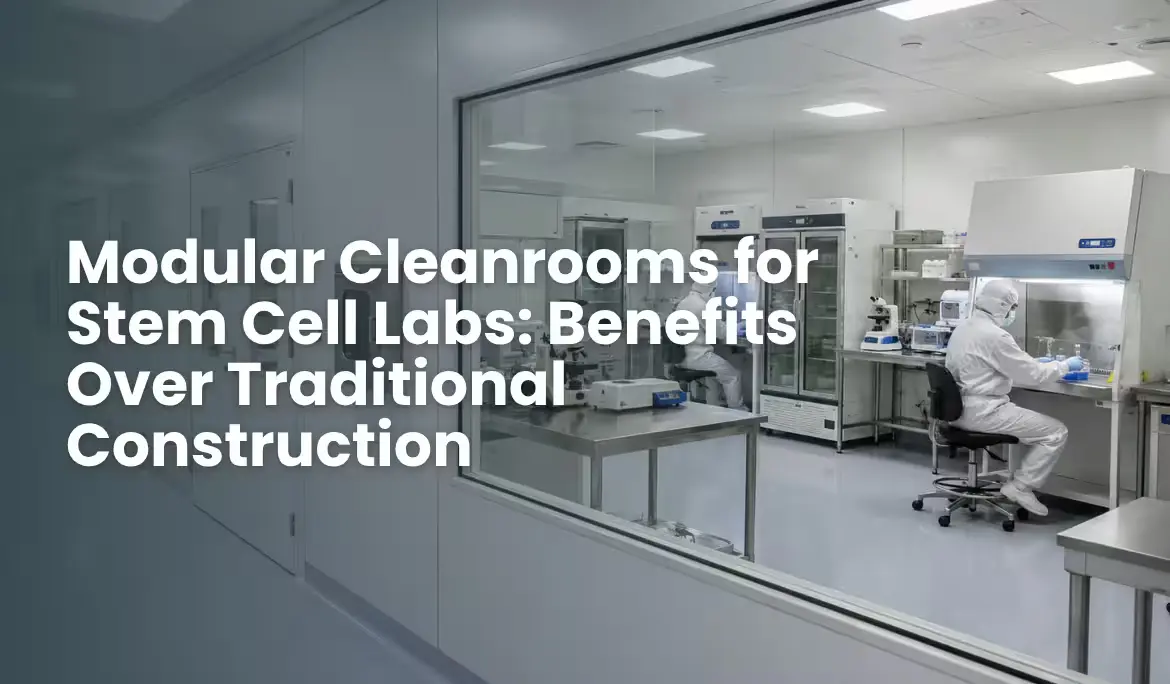
Building a cleanroom for a stem cell lab isn’t like building one for a standard manufacturing facility. The stakes are different. The cells you’re protecting often can’t be replaced if something goes wrong.
That’s pushing more labs to look at modular construction instead of the traditional build-it-on-site approach. Modular isn’t new, but it’s becoming the default for teams that can’t afford a slow, unpredictable construction timeline or a validation surprise after the walls are already up.
Here’s what modular actually means, how it stacks up against traditional construction, and what to check before you choose a provider.
Why Do Stem Cell Labs Need Different Cleanroom Requirements Than Other Facilities?
Stem cell labs aren’t just another cleanroom project. A single contamination event doesn’t just fail a batch. It can compromise a patient’s own cells, which in cell therapy work are often irreplaceable.
That changes the calculus on everything. Air changes per hour, pressure cascades between rooms, growing protocols, all of it gets stricter because the margin for error is smaller.
Most stem cell and cell therapy labs operate under ISO 14644 classifications alongside cGMP requirements, since the work often intersects with both research and clinical-grade manufacturing. validation testing for controlled environments like this includes filter integrity leak tests, airborne particle counts, air flow visualization, and pressure balancing, among other checks.
That’s the baseline. The question is which construction approach actually holds up to it over time.
What's the Problem With Traditional Construction for Cell Therapy Labs?
Traditional cleanroom construction means building the room on site, from framing to finishes. Walls get built in place. Seams get sealed in place. Every joint is a potential leak point that gets tested for the first time after the room already exists.
For a stem cell lab, that’s a slow way to find out something’s wrong. If a wall assembly fails a filter integrity test post-construction, you’re not swapping a panel. You’re reopening a wall.
There’s also the timeline problem. On-site fabrication depends on weather, labor availability, and sequencing that’s hard to compress. If your lab is racing toward a clinical trial start date or a production milestone, every week added to construction is a week added to revenue or research delay.
None of this makes traditional construction wrong. It just means the tradeoffs hit harder in a facility where downtime and rework carry higher stakes.
What Does Modular Cleanroom Construction Actually Mean?
Modular cleanroom construction uses pre-fabricated wall panels, ceilings, and components built and tested off-site, then assembled on location instead of built from scratch in place.
Standard modular panel construction uses a composite build, typically two skins of galvanized or pre-coated steel over a framework, with a sealed, insulated interior. Panels come in standard widths and thicknesses, which is part of why they assemble faster and more consistently than a built-in-place wall.
The components arrive already manufactured to spec. On-site work becomes assembly, not fabrication. That’s the core distinction, and it’s what drives most of the practical advantages for a lab environment.
Already mapping out a stem cell lab build?
FTS Cleanrooms designs and manufactures modular panel systems in-house, so you’re not coordinating separate vendors for panels, HVAC, and validation.
How Much Faster Is a Modular Cleanroom to Get Operational?
This is where the timeline math actually changes. Because panels and components are manufactured off-site while site prep happens in parallel, you’re not waiting on sequential on-site fabrication before the room takes shape.
FTS Cleanrooms in-house manufacturing model pairs pre-fabricated modular infrastructure with EC+ fan systems for airflow, built specifically to shorten the gap between design sign-off and a room that’s ready for validation.
For a stem cell lab, that compressed timeline usually matters more than it would for a lower-risk facility. Every month a lab isn’t operational is a month of grant funding, trial enrollment, or manufacturing capacity sitting idle.
Can a Modular Cleanroom Scale as Your Stem Cell Lab Grows?
Stem cell and cell therapy protocols change. A lab that starts with a single ISO 7 suite for early research often needs to add ISO 5 zones, additional gowning rooms, or a second process line as the work moves toward clinical or commercial scale.
Traditional construction makes that expansion a full renovation. Walls come down, systems get rerouted, and the existing room is often out of service while it happens.
Modular panel systems are built to be reconfigured. Panels can be moved, added, or removed without demolishing the surrounding structure, which means a lab can adjust its footprint as its program evolves instead of committing to one fixed layout for the life of the facility.
That flexibility is one of the more underrated reasons modular fits research-driven environments like cell therapy labs, where the science moves faster than a five-year facility plan usually accounts for.
Is a Modular Cleanroom Easier to Validate?
Validation is where a lot of cleanroom projects run into trouble, regardless of how they were built. But modular construction has a structural advantage here: consistency.
Because panels are manufactured to a standard spec rather than built by hand on site, the variability between one wall joint and the next is lower. That consistency makes it easier to predict how a room will perform before validation testing even starts.
validation services are aligned with ISO 14644, EU cGMP, USFDA, WHO, EMEA, and MHRA standards, and testing covers filter integrity leak tests, recovery time studies, airborne particle count, air flow visualization, air velocity measurement, air changes per hour, pressure balancing, and temperature and humidity testing.
For a stem cell lab, having a provider who designs, builds, and validates under one scope matters here specifically. If the same team is accountable for the panel install and the validation result, there’s no gap where a construction issue gets blamed on the mechanical system, or vice versa.
What Should You Look for in a Modular Cleanroom Provider for Stem Cell Work?
Before you commit to a provider, get clear answers on a few things:
- Do they manufacture panels in-house, or source and assemble third-party components?
- Can they show validation testing that covers your specific ISO classification and regulatory framework?
- Is design, construction, and validation handled under one contract, or will you be coordinating multiple vendors?
- Have they worked on stem cell, cell therapy, or comparable high-containment biotech projects before?
FTS Cleanrooms’ turnkey solution scope covers design and build through cleanroom panels, doors, furniture, equipment, and validation, with experience across pharmaceutical, biotech, and healthcare applications including controlled environments like stem cell facilities.
If a provider can’t speak clearly to all four of those points, that’s worth pausing on before you sign anything.
Ready to scope your modular cleanroom project?
FTS Cleanrooms handles design, construction, and validation under one contract, so there’s no gap between the build and the compliance result.
FAQs
Timelines vary by room size, ISO classification, and site conditions. What’s consistent is that pre-fabricated components are manufactured off-site while site prep happens in parallel, which is the main reason modular projects tend to move faster than fully on-site builds.
It depends on the process. Isolation, expansion, and culture work often require different grades within the same facility, commonly ranging from ISO 7 support areas to ISO 5 critical zones. A qualified provider should assess your specific protocols rather than assume one classification fits the whole lab.
Minimum 2mm self-levelling epoxy for light-traffic Grade C/D areas. 3–6mm epoxy mortar for Grade B environments, high-traffic corridors, and areas with wheeled or forklift traffic. Thin-film epoxy coatings below 1mm are not appropriate for classified pharmaceutical areas.
Modular panel systems are designed to be added to or reconfigured without demolishing the surrounding structure. Whether an expansion can happen without downtime depends on layout and where new space connects to the existing room, so raise this at the design stage.
Yes. Validation testing applies the same regardless of how the room was built. validation aligns with ISO 14644, EU cGMP, USFDA, WHO, EMEA, and MHRA standards regardless of construction method.
This varies by provider. Some cleanroom companies handle design, build, and validation under one contract, which removes the handoff risk between construction and compliance testing. Others build the room and leave validation to a separate vendor, which is worth clarifying before you sign a contract.