Aerospace Cleanroom Standards: What Satellite and Defense Manufacturers Need to Know
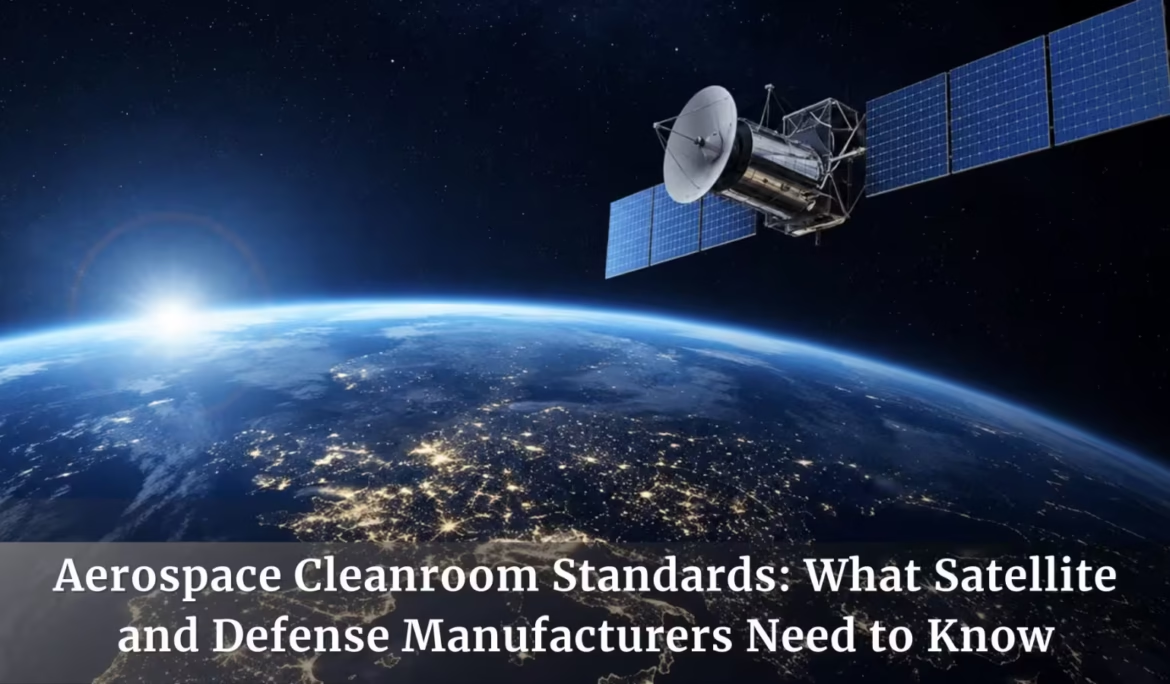
The space domain is perhaps the most inhospitable of all domains for humanity to explore. Once a device like a satellite, rover, or defense payload is in orbit, there is no way to conduct any kind of maintenance and repair of the device. One grain of dust on a camera lens or trace of chemical on an optical sensor could ruin a million dollar mission.
For the aerospace and defense industries, the road to the stars starts not at the launch pad but in a precisely controlled clean room.
As the Middle East fast becomes a major player in the space industry (fuelled by entities such as the UAE Space Agency and Saudi Vision 2030), there is a huge need for facilities that allow the manufacture of highly sensitive equipment. Here follows an analysis of what goes into aerospace clean rooms and satellite assembly.
The Astronomical Cost of Contamination
In pharmaceutical cleanrooms, the primary goal is preventing biological contamination (bacteria and microbes) to protect human health. In aerospace, the enemy is primarily particulate and molecular contamination.
If aerospace components are not assembled in an ultra-clean environment, several catastrophic failures can occur:
- Optical Degradation: A single speck of dust can scatter light, effectively blinding high-resolution telescopes, star trackers, or military targeting sensors.
- Thermal Control Failure: Spacecraft rely on highly specific thermal coatings to manage the extreme temperature swings of space. Contaminants can alter the absorption and emittance properties of these surfaces, causing the craft to overheat or freeze.
- Electrical Shorts: Conductive microscopic particles can easily bridge the microscopic gaps in modern circuit boards, causing short circuits that disable vital navigation or communication systems.
- Airborne Molecular Contamination (AMC): This is a unique threat to aerospace. Volatile Organic Compounds (VOCs) from adhesives, plastics, or human skin oils can settle on a spacecraft. In the vacuum of space, these compounds “outgas” and then condense on the coldest surfaces, which are usually the critical optical lenses, creating a cloudy film that ruins the mission.
Decoding Aerospace Cleanroom Classifications (ISO 14644-1)
Aerospace cleanrooms do not operate under a single, uniform classification. Because spacecraft are massive and complex, facilities typically employ a “nested” design, where cleanliness levels increase as you move closer to the most sensitive components.
- ISO Class 8 (Federal Standard Class 100,000): Used for the general manufacturing of structural components, outer chassis assembly, and material staging.
- ISO Class 7 (Federal Standard Class 10,000): The standard for sub-assembly integration, satellite bus construction, and testing of non-optical electronic components.
- ISO Class 5 (Federal Standard Class 100): The most mission-critical zone. This is reserved for the assembly and integration of sensitive optical payloads, exposed focal plane arrays, and final fairing encapsulation before launch.
Unique Engineering Challenges in Aerospace Cleanrooms
Designing a cleanroom for aerospace or defense is fundamentally different from designing one for healthcare or microelectronics. Facility managers and engineers must account for several unique variables:
1. Massive Scale and “High-Bay” Architecture
Satellites and launch vehicles are massive. Aerospace cleanrooms often require “high-bay” architectures with ceiling heights exceeding 10 to 15 meters. Maintaining positive pressure, uniform temperature, and laminar airflow in such a massive volume requires incredibly powerful, specialized HVAC systems and strategic return-air placements to prevent dead zones.
2. Cleanroom Cranes and Material Handling
You cannot move a 5-ton satellite chassis by hand. Heavy-duty overhead cranes are mandatory in aerospace cleanrooms. However, traditional cranes generate immense particulate contamination through metal-on-metal friction and lubricating oils. Aerospace facilities require specialized, enclosed cleanroom cranes utilizing specialized belts and non-outgassing lubricants to ensure lifting operations do not shower the payload with debris.
3. Strict Electrostatic Discharge (ESD) Control
Static electricity is a silent killer of aerospace electronics. The cleanroom must be designed as a complete ESD-safe environment. This requires anti-static flooring, grounded modular wall panels, and precise humidity control (usually maintained between 40% and 55% RH) managed by the facility’s HVAC system to prevent static buildup while avoiding condensation.
4. Vibration Control
For defense contractors building guidance systems or aerospace engineers aligning optical arrays, even the micro-vibrations from a passing truck or the facility’s own HVAC chillers can throw off calibrations. These cleanrooms often require isolated concrete foundation slabs decoupled from the rest of the building.
Future-Proofing with Modular Cleanroom Panels
Historically, aerospace facilities were built using traditional stick-built construction. Today, the industry is shifting aggressively toward Modular Cleanrooms.
Modular cleanroom panels offer distinct advantages for aerospace and defense contractors. They are manufactured with non-shedding, non-outgassing finishes perfectly suited for AMC control. Furthermore, because the aerospace industry is highly dynamic, modular systems allow facilities to expand their footprint, raise ceiling heights, or upgrade an ISO Class 7 space to an ISO Class 5 space without demolishing the building.
Getting the classification right is only half the job; constructing a structure capable of maintaining ISO 5 tolerances on a high bay level is the difficult one. FTS Cleanrooms has built ISO certified modular cleanrooms for the pharmaceutical, biotechnology, semiconductor, aerospace, and industrial projects within the GCC region over the past two decades.
FAQs
Most aerospace facilities run a nested range rather than one single class. ISO Class 8 typically covers general structural manufacturing, ISO Class 7 covers sub-assembly and satellite bus integration, and ISO Class 5 is reserved for optical payload assembly, focal plane arrays, and final fairing encapsulation.
AMC refers to volatile organic compounds — from adhesives, plastics, or skin oils — that settle on spacecraft surfaces. In the vacuum of space, these compounds outgas and condense on the coldest surfaces, usually optical lenses, forming a film that can degrade sensors and optics.
Satellites and launch vehicles are physically massive, so aerospace cleanrooms often need ceiling heights of 10 to 15 metres or more. That scale requires specialized HVAC systems and carefully placed return-air points to maintain positive pressure and laminar airflow without dead zones.
Pharmaceutical cleanrooms are built primarily to control biological and microbial contamination. Aerospace cleanrooms are built to control particulate and molecular contamination, and typically add requirements — ESD control, vibration isolation, and heavy-duty material handling — that pharmaceutical facilities don’t need.
Yes. Because modular cleanroom panels aren’t tied to a fixed structural build, facilities can raise ceiling heights, expand footprint, or upgrade filtration and airflow to move a space from ISO Class 7 to ISO Class 5 without demolishing the existing building.