The Complete Guide to Turnkey Cleanroom Installation: From Engineering to Validation
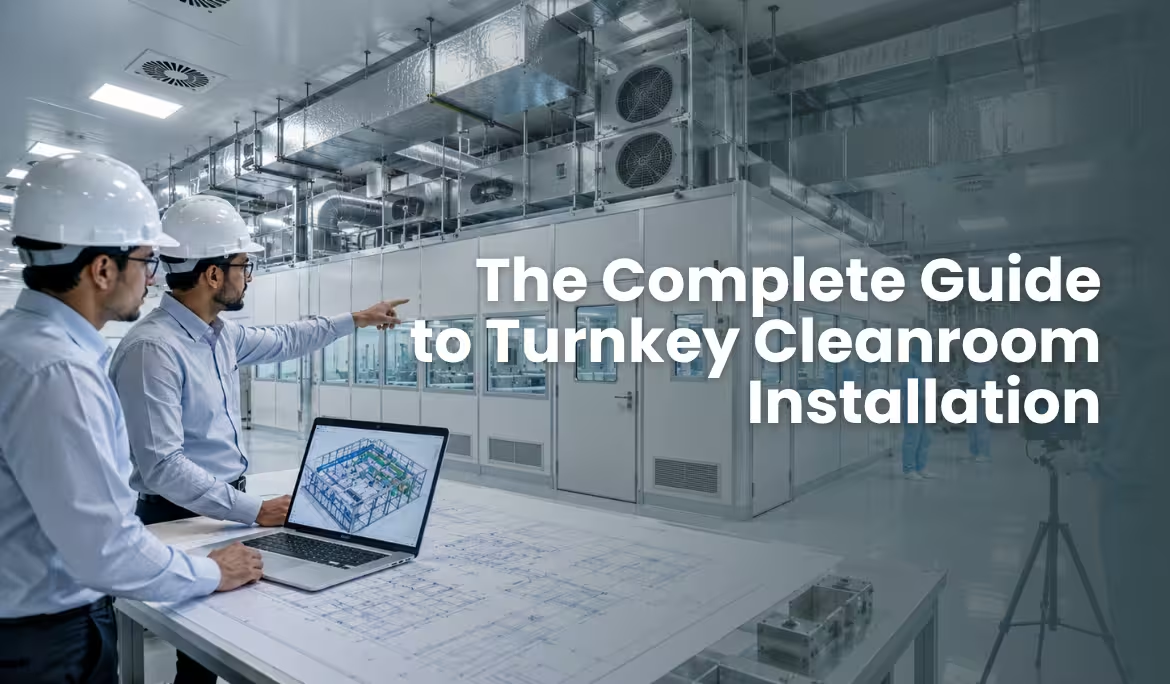
Controlled environment builds carry real financial and regulatory stakes, cost overruns, missed deadlines, and compliance failures aren’t abstract risks, they’re what happens when a project’s accountability is split across too many hands.
The Problem: In a traditional multi-vendor approach, architects, HVAC contractors, panel suppliers, and validation consultants each own a piece of the project but no one owns the whole. When a room fails its particle count test the night before a regulatory inspection, three vendors point at each other while the client absorbs the cost, the delay, and the compliance consequence.
The Solution: A turnkey cleanroom solution provider that designs, manufactures, builds, and validates under one contract removes that gap entirely. One point of accountability, from layout to final sign-off.
Why Does a New Production Line Threaten Your ISO Classification?
A turnkey cleanroom solution combines design, manufacturing, construction, mechanical integration, and validation under a single provider. The walls and ceiling arrive as factory-manufactured panels built to fixed tolerances rather than being built up on-site from raw materials, which is what makes the delivery model genuinely different from piece-by-piece construction, not just faster, but structurally different in how risk and tolerances are controlled.
| Project Metric | Traditional Multi-Vendor Approach | Turnkey Solution |
| Contractual Risk | Split between 3-5 different companies | 100% assumed by the turnkey provider |
| Design Integration | Prone to structural/HVAC layout conflicts | Process-driven, collaborative engineering |
| Installation Speed | Linear and slow, awaits sequential site handoffs | Accelerated through parallel factory panel fabrication |
| Compliance Ownership | Client must coordinate final certification | Delivered fully certified and operational |
How Do You Plan a High-Performance Cleanroom Layout?
Most cleanroom layout failures begin before a single panel is installed, at the planning stage, when the layout is designed around available floor space rather than the processes that will run inside it.
Process-First Design means the architecture adapts to the equipment, the workflows, and the people, not the other way around.
- Airflow and Pressure Cascades: Air must flow from the cleanest zones to progressively less-clean zones. This positive pressure difference is the primary barrier against particle and microbial ingress into critical areas.
- Material Flow vs. Personnel Flow: Material routes and personnel routes need separation, ideally through airlocks, since crossing paths are a common, hard-to-trace contamination source.
💡 From the Desk of the Lead Mechanical Engineer: “Never overlook the material airlock (MAL) sizing. Companies often plan layouts based on the footprint of their manufacturing equipment but forget to measure the width of the forklifts or pallets needed to load that equipment. If it doesn’t fit through the airlock, your production line stalls before it starts.”
What Are the Key Stages of a Turnkey Cleanroom Installation?
Conceptual Engineering & ISO Classification Alignment
Establishing the exact ISO classification, allowable particulate concentration, and required air changes per hour before any component is specified.
Factory Panel Manufacturing
Wall and ceiling panels are manufactured to fixed tolerances under factory conditions: PCGI (pre-coated galvanized iron) skins of 0.6-0.8mm thickness over a GI structural framework, with Rockwool or PUF insulation cores sandwiched between the two skin layers. Standard wall panel thickness runs 50-100mm depending on project requirements; ceiling panels are typically 50-75mm and rated to carry a walkable load of up to 250 kg/m² distributed load.
Structural Envelope Assembly
Panels are erected on-site using aluminum panel-connecting profiles and GI base runners, sealed horizontally and vertically with RTV-grade silicone for a flush finish. Doors are fitted flush into the panel system at this stage; electromagnetic interlocking systems, where specified, are built into the structure as it rises.
HVAC & Air Handling Integration
Custom-built double-skin Air Handling Units (50mm PUF panel, thermal-break profiles) are installed with terminal HEPA filter boxes (H14 grade, gel-seal gasketed, with DOP test ports) and Class 0-rated insulated GI ductwork. Air balancing, pressure cascades, and fire dampers (90-minute rated) are commissioned at this stage. For facilities prioritizing energy efficiency, FTS’s EC+ fan systems are also available as part of the HVAC package, measurably reducing ongoing energy costs compared to standard fan setups.
Utility Hookups & Tool Integration
Process piping, electrical drops, and environmental monitoring sensor wiring are routed to their connection points, planned from the design stage so the validated envelope is genuinely production-ready at handover.
Why Is "Clean Construction" Crucial During On-Site Assembly?
Particle contamination from construction doesn’t disappear once the HVAC system is switched on. Surface contamination, cardboard fibers, drywall dust, shoe particulates, gets trapped in unsealed joints and re-entrains during the first weeks of operation, a documented cause of early batch failures and audit findings in pharmaceutical and biotech facilities.
The 3-Stage Clean Construction Framework:
- Stage 1, Particulate Mitigation: Heavy structural work (panel alignment, ceiling grid erection). Active dust collection runs continuously; waste material exits the construction zone daily.
- Stage 2, Micro-Cleanliness: Once panels are sealed and the envelope is closed, shoe covers become mandatory and wood/cardboard are prohibited past the demarcation line.
- Stage 3, Absolute Containment: Before validation testing, full cleanroom smocks, gloves, and hoods are required for all technicians inside the space.
How Is Cleanroom Compliance Verified and Validated?
A complete validation package runs through four qualification stages:
- Design Qualification (DQ): Confirms the approved design meets the facility’s intended use and regulatory requirements before construction begins.
- Installation Qualification (IQ): Documented proof that all installed hardware, panels, filters, HVAC components, matches the approved design drawings and specifications.
- Operational Qualification (OQ): Testing the facility “at rest,” air balance, pressure cascades, HEPA filter integrity (DOP/PAO leak testing), recovery time, and air change rates against defined acceptance criteria.
- Performance Qualification (PQ): Testing “in operation,” with personnel and equipment running, confirming particle counts, microbial levels, and pressure cascade integrity hold under real production conditions.
The end deliverable is a complete documentation package, DQ/IQ/OQ/PQ protocols and reports, ready for submission to the relevant regulatory authority.
Frequently Asked Questions
Panelized (modular) construction uses factory-manufactured panels, PCGI skins over a Rockwool or PUF core, assembled on-site, rather than building walls up from raw materials like drywall and studs. The factory environment allows tighter tolerance control on seals and joints, a meaningful advantage for ISO 5 and stricter classifications where even minor wall-to-HVAC misalignment can cause validation failure.
Timelines depend on facility size and system complexity, but as an average across comparable FTS projects (factory panel fabrication, HVAC integration, and validation included), installation runs 16-18 weeks from order confirmation to delivery. Larger or more complex facilities will run longer.
Panelized delivery can achieve environments from ISO Class 3 up to ISO Class 9. Single-source delivery matters most at the stricter end, ISO Class 5 and below, where coordination between the wall system and HVAC commissioning is critical to passing validation on the first attempt.
Yes. The panel system can be assembled as a self-supporting envelope inside an existing building, with the engineering team evaluating slab levelling, ceiling clearance, and utility capacity before design begins, avoiding structural changes to the host building.
In a true turnkey contract, the provider owns 100% of the compliance sign-off and does not hand over the facility until it passes certified testing and a complete, inspector-ready validation package (DQ/IQ/OQ/PQ) is delivered.
Conclusion & Call to Action
Managing multiple vendors across a cleanroom project doesn’t distribute risk, it multiplies it. A single turnkey provider handling design, manufacturing, construction, HVAC, and validation removes that risk at the source.
Request a Turnkey Cleanroom Engineering Consultation → Speak directly with a cleanroom design engineer about your facility footprint, ISO target, and timeline.