EC+ Fan System: The Smart Way to Cut HVAC Energy Costs by Up to 50% Without Replacing Your Entire System
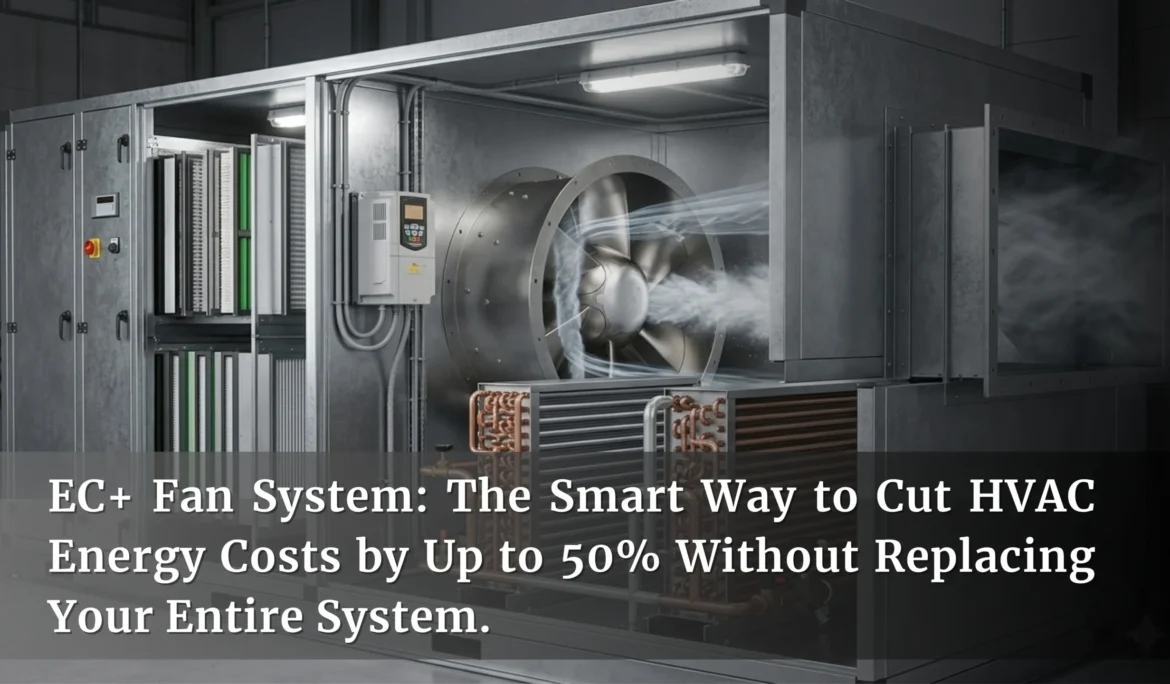
Energy costs are one of the fastest-growing operational expenses for facilities across every industry. Whether you manage a pharmaceutical cleanroom, a hospital, a warehouse, or a manufacturing plant, your HVAC system is almost certainly one of your biggest energy consumers — and most facilities are running fans that are decades behind in efficiency.
The good news? You do not need to rip out your entire HVAC system to fix it. The EC+ Fan System by FTS Cleanrooms is a plug-and-play upgrade that slots directly into your existing Air Handling Units (AHUs) and can cut your fan energy consumption by up to 50%.
In this article, we break down exactly what EC+ fans are, how they work, which industries benefit most, and how to calculate whether an upgrade makes financial sense for your facility.
1. What Is an EC+ Fan System? (And Why It Matters)
EC stands for Electronically Commutated. Unlike traditional AC induction motors used in most HVAC fans, EC motors use permanent magnets and variable-speed electronics to deliver precise, demand-driven airflow. The result is dramatically better efficiency at every point in the system’s operating range.
The EC+ concept by FTS Cleanrooms takes this technology further by combining:
- High-efficiency EC motors (up to 92% motor efficiency)
- Direct-drive technology — eliminating belts and their associated energy losses
- Aerodynamically optimised impeller design for maximum airflow per watt
- Demand-based speed control for real-time energy matching
| Performance Metric | EC+ Fan System |
| System Efficiency | Up to 85% |
| Motor Efficiency | Up to 92% |
| AHU Power Reduction | 40–50% |
| Typical ROI Period | 12–24 months |
| Operational Lifespan | 20+ years |
| Noise/Vibration | Lower (no belts) |
For facilities already running Cleanroom HVAC Systems, the EC+ Fan System is the logical next step in optimising airflow performance and reducing long-term energy expenditure.
2. How EC+ Fans Achieve Energy Savings: The Technical Breakdown
Traditional HVAC fan systems use belt-driven AC motors running at fixed speeds. They work — but they waste energy in multiple places simultaneously. Here is where the losses come from and how EC+ fans eliminate each one:
2a. Eliminating Belt Losses
In a conventional fan, a belt connects the motor to the fan impeller. Belts introduce friction, slip, and wear — and they consume energy just by existing. A typical belt-drive system loses 5–10% of motor output before the air even moves. EC+ fans use direct-drive technology, meaning the motor and impeller are directly coupled, eliminating belt losses entirely.
2b. Speed Control Based on Demand
Most legacy HVAC fans run at full speed regardless of actual airflow demand. EC+ fans use integrated variable-speed control to precisely match fan speed to the real-time ventilation requirement. Since fan power scales with the cube of speed (fan laws), even a 20% reduction in speed can reduce power by nearly 50%.
2c. Optimised Aerodynamic Impeller Design
The impeller, the rotating blade assembly is engineered specifically for maximum aerodynamic efficiency. This means more air moved per unit of electrical energy consumed, improving the Specific Fan Power (SFP) rating of the system.
3. Who Should Upgrade? EC+ Fan Applications by Industry
The EC+ Fan System is not a niche solution. It is a broad-spectrum upgrade suited to any facility running Air Handling Units. Here are the industries that benefit most:
Pharmaceutical & Cleanroom Facilities
Cleanrooms operate around the clock under strict air change rate (ACR) requirements. The energy cost of maintaining HEPA-filtered, temperature-controlled air 24/7 is enormous. EC+ fans are the ideal solution for cleanroom HVAC systems, delivering consistent airflow while cutting the energy bill significantly. EC+ fan retrofits ensure both compliance and energy performance.
Hospitals & Healthcare Facilities
Healthcare environments including operation theatres, compounding pharmacies, and inpatient pharmacies — demand precise, reliable ventilation. EC+ fans deliver quieter, more stable airflow with lower maintenance overhead than belt-driven alternatives, which is critical in patient-care environments.
Airports & Commercial Facilities
Airports, Malls and Hotels operate 24/7 with massive ventilation demands across areas. EC+ fans offer scalable, energy-efficient airflow management that adapts to density and zone-specific requirements. By optimizing energy consumption across large HVAC systems, they enable electricity bill reductions of up to 50%, significantly lowering operational expenses.
Beyond cost savings, EC+ fans play a vital role in reducing carbon emissions by lowering overall power consumption, directly supporting airport sustainability goals and green building initiatives.
Manufacturing & Industrial Facilities
Manufacturing plants run large AHU banks continuously. The cumulative energy savings from an EC+ retrofit across multiple units can be substantial. In process-critical environments, the added benefit of reduced vibration and noise also improves working conditions and equipment longevity.
Warehouses & Logistics Centres
Large warehouses with wide ventilation zones benefit from demand-based speed control. EC+ fans adjust output dynamically based on occupancy, temperature, or CO₂ levels, avoiding the energy waste of fixed-speed operation across large, partially occupied spaces.
Laboratories & Research Facilities
Labs including IVF lab setups require stable, low-contamination airflow. EC+ fans eliminate belt particulates (a real concern in sensitive lab environments) and provide ultra-stable airflow control.
4. The ROI Calculation: When Do EC+ Fans Pay for Themselves?
Let us be direct: EC+ fan upgrades are an investment. But it is one of the fastest-returning energy investments available in facility management. Here is a simplified example of how ROI is calculated:
Example Scenario: A Single AHU Fan Retrofit
- Legacy fan motor power consumption: 15 kW
- EC+ fan motor power consumption: 7.5 kW (50% reduction)
- Daily operation: 20 hours
- Annual energy saved: 7.5 kW × 20 hrs × 365 days = 54,750 kWh/year
- Electricity tariff (UAE example): AED 0.38/kWh
- Annual savings: ~AED 20,805
5. EC+ Fan Retrofits: What the Installation Process Looks Like
One of the most common concerns facilities managers have about HVAC upgrades is disruption. The EC+ Fan System is specifically designed to minimise this. Here is what the installation process typically involves:
- Site Assessment: FTS Cleanrooms evaluates your existing AHU configuration, current fan performance, and energy consumption baseline.
- Fan Selection: The correct EC+ blower fan size and specification is matched to your AHU dimensions and airflow requirements.
- Plug-and-Play Installation: EC+ fans slot into existing AHU housings with minimal structural modification. This is not a full HVAC replacement — it is a targeted component upgrade.
- Controls Integration: The EC+ motor’s speed controller is wired into your building management system (BMS) or standalone controls for demand-based operation.
- Commissioning & Verification: Airflow performance is verified post-installation, ensuring your system meets its target specifications before handover.
The plug-and-play nature of EC+ fan retrofits means most installations can be completed during scheduled maintenance windows, with little to no production downtime required.
6. Environmental Impact: EC+ Fans and Sustainability
Beyond the financial case, the EC+ Fan System supports broader environmental and sustainability goals — increasingly important for organisations operating in UAE, KSA, and across the MENA region, where green building standards and energy regulations are tightening.
- CO₂ Reduction: By consuming significantly less electricity, EC+ fans directly lower a facility’s carbon footprint.
- Green Building Compliance: Improved SFP ratings support compliance with ASHRAE 90.1, LEED, Estidama (UAE Pearl Rating System), and similar frameworks.
- Long Operational Life: With a 20+ year lifespan and minimal moving parts, EC+ fans also reduce the environmental impact of frequent replacements and maintenance waste.
- Reduced Refrigerant Load: More efficient airflow can reduce the workload on cooling systems, indirectly lowering refrigerant consumption.
Poor equipment placement can block airflow and create disturbances. Even small changes in layout can significantly impact airflow performance.
7. Frequently Asked Questions (FAQ)
In most cases, yes. EC+ fans by FTS Cleanrooms are designed as AHU blower fans with plug-and-play integration, requiring minimal structural modification to existing Air Handling Units. The FTS engineering team assesses compatibility during the initial site survey.
Depending on your current system, EC+ fans can reduce AHU power consumption by 40–50%. In optimal configurations — where legacy belt-drive fans are being replaced — motor-level efficiency can reach 92% and overall system efficiency up to 85%.
EC+ fans have fewer moving parts than belt-driven alternatives — no belts, pulleys, or tensioners to service. Maintenance requirements are minimal, contributing to their 20+ year operational lifespan. This also reduces maintenance downtime, a key benefit for critical facilities like hospitals and cleanrooms.
No. Direct-drive EC+ fans produce significantly less vibration and noise than belt-driven systems. This is particularly beneficial in healthcare and laboratory environments where acoustic comfort matters.
FTS Cleanrooms reports ROI periods of 12 to 24 months depending on system operating hours and local electricity tariffs. Facilities running AHUs 20+ hours per day at higher electricity rates tend to see the fastest returns.
Yes. EC+ fan speed controllers are designed to integrate with standard building management systems (BMS), allowing demand-based control without requiring a full controls overhaul.