Why Your Pharma Cleanroom Passed ISO Certification But Will Fail Your Next GMP Audit
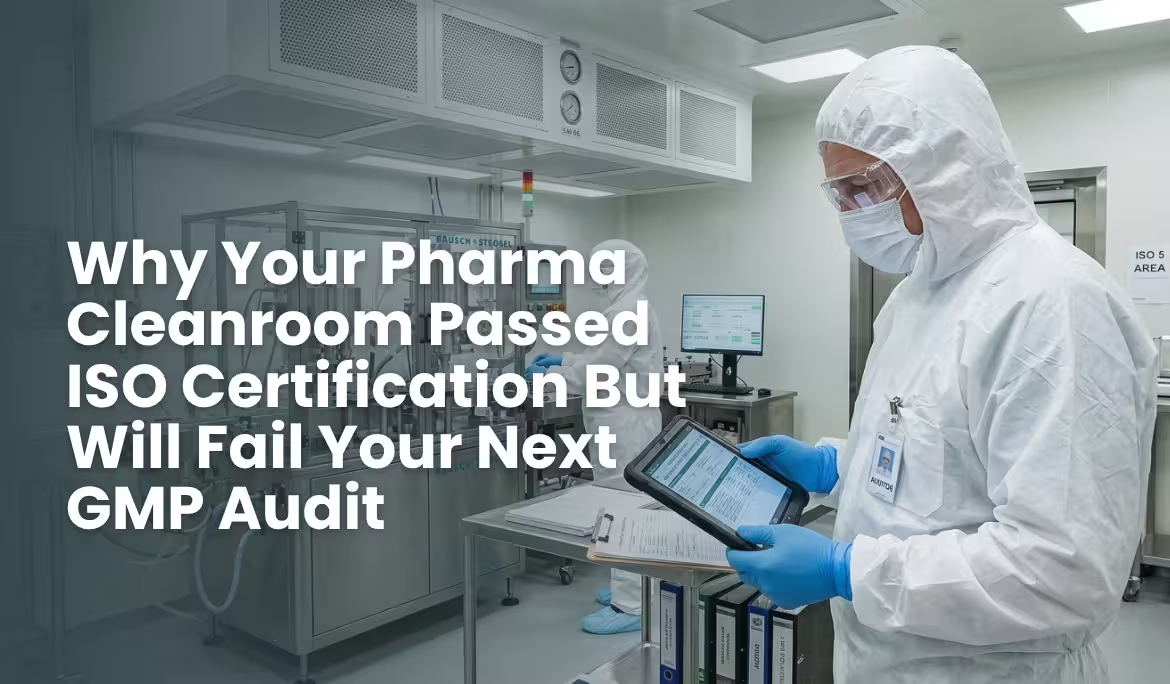
Your ISO certificate is framed on the wall. Your particle counts are within limits. Your pharma cleanroom solutions are running exactly as designed. And yet – a GMP auditor walks through the door, and within the first hour, the red flags begin.
This is not a hypothetical. It is one of the most common – and most costly – scenarios faced by pharmaceutical manufacturers across the UAE, GCC, and beyond. ISO certification and GMP compliance are not the same thing. They never have been. But too many facilities treat them as if they are, investing in cleanroom validation solutions to earn the certificate and then operating as though the work is done.
Is ISO 14644-1 Really Enough for a GMP Cleanroom?
ISO 14644-1 is an engineering standard. It defines cleanliness classes for airborne particles, from ISO 5 to ISO 9. It also sets the testing methods to confirm these classifications. It is a critical foundation. But it answers one question only: how clean is the air, right now, in this room?
GMP – whether EU GMP, WHO GMP, or PIC/S – asks an entirely different set of questions. It asks how the room behaves during production. It asks whether your documentation proves consistent control. It asks if your people, processes, and systems work together. Do they reduce contamination risk? It’s not just about passing a particle count test.
ISO 14644 vs GMP: A Critical Distinction
- ISO 14644: Particle concentration at a specific point in time (at-rest or as-built)
- EU GMP Annex 1: Microbial monitoring, pressure cascades, continuous in-operation data, gowning qualifications, and media fill studies
- GMP and ISO cleanroom standards differ mainly in operational evidence, not engineering specs.
A cleanroom classified as ISO 7 or ISO 8 might meet your engineering consultant’s needs. Your GMP inspector won’t be satisfied automatically. You need operational data, SOPs, training records, and risk assessments to support it.
Why Does Your Documentation Often Trigger the First Red Flag?
In a GMP audit, documentation is not administrative overhead. It is evidence. And it is almost always the first place an auditor looks. Pharma companies often face cleanroom compliance gaps, and they’re usually not mechanical. Instead, they stem from issues with documentation.
Qualification vs. Certification
A particle count certificate from a third-party testing body proves your cleanroom was clean on the day of testing. A qualification-IQ, OQ, PQ-shows your cleanroom system is designed correctly. It works consistently and performs well during production. These are not the same document. Many facilities hold one and present it as the other. Cleanroom qualification and certification are not just different terms. They represent what an ISO tester checks versus what a GMP auditor demands.
Outdated SOPs
Standard Operating Procedures must reflect how the room actually operates today – not how it was designed to operate two years ago. If your HVAC system was modified, if personnel flows changed, if new equipment was added – your SOPs must reflect that. Auditors cross-reference SOPs against physical observations. Discrepancies become findings.
Missing Change Control Records
Any major change in a classified environment must have an impact assessment. It also needs re-qualification if necessary and proper approval records. Informal changes, even tiny ones, can cause GMP audit failures if there’s no proper documentation.
Environmental Monitoring Gaps
Are your environmental monitoring data complete, reviewed, and trended? Are out-of-limit events investigated and formally closed? A single unresolved OOL finding with no CAPA can derail an otherwise successful audit.
Are Your SOPs Undermining Your Mechanical Controls?
Your HEPA filters perform. Your pressure differentials hold. Your air change rates are within spec. And yet – your SOPs allow personnel to prop open the gowning room door during busy shift changes.
This is the gap between cleanroom design mistakes that pharma teams often miss. Auditors, on the other hand, always find these issues. Mechanical controls create the environment. SOPs govern the people who work within it. When the two are misaligned, contamination risk rises whether or not a particle counter detects it.
Common SOP-to-Mechanical Misalignments
- Gowning sequence breakdowns: EU GMP cleanroom rules need a clear gowning process. This process must follow steps for Grade A/B areas. Vague SOPs or those that don’t fit the gowning room design can create contamination pathways. The room’s mechanical systems can’t fix these issues.
- Material entry controls: Every item that enters a classified zone can bring contamination. SOPs must outline surface decontamination needs, staging steps, and time limits. These procedures should be doable within the layout of your pass-through hatches and airlocks.
- Cleaning and disinfection validation: The 2022 revision of EU GMP Annex 1 says you must validate cleaning procedures. You also need to validate disinfection procedures. It’s not enough to just do them. Document and justify the rotation of disinfectants, contact times, and surface compatibility.
Is Your Airflow Visualization (Smoke Testing) Telling the Whole Story?
Smoke studies, which test airflow visualization, are often misunderstood in GMP cleanroom compliance. They are frequently performed as a one-time qualification exercise, documented in a report, and filed. This is not sufficient.
EU GMP Annex 1 and FDA guidance require airflow visualization to show unidirectional and non-turbulent flow. This protects the critical zone even in the worst-case operational conditions. The study must use working equipment and have staff on-site. They should carry out real production tasks while facing the highest risk of contamination.
What Auditors Look for in Smoke Study Documentation
Large warehouses with wide ventilation zones benefit from demand-based speed control. EC+ fans adjust output dynamically based on occupancy, temperature, or CO₂ levels, avoiding the energy waste of fixed-speed operation across large, partially occupied spaces.
Laboratories & Research Facilities
- Was the study conducted in-operation – not at-rest or in an empty room?
- Does the video evidence show full coverage of the critical zone, including under laminar flow units?
- Were interventions – glove changes, sample collections, equipment adjustments – included?
- Is there a risk assessment justifying the selected worst-case scenarios?
- When was the study last repeated following any change to equipment layout, HVAC settings, or production workflow?
Airflow visualization is often done just once during qualification. This is a common finding in cleanroom audits for pharma in the region. The smoke study is not a certificate. It is ongoing evidence of a system that continues to work.
Why Do Material and Personnel Flows Matter More Than Particle Counts?
Particle counts measure contamination already present. Material and personnel flow controls prevent contamination from entering in the first place. In GMP thinking, prevention is more important than detection. This is where the ISO-to-GMP gap matters most.
ISO 14644 doesn’t cover how people move in your facility. It also doesn’t address how raw materials and components are routed. Plus, it doesn’t specify if your Grade C corridor connects directly to your Grade A filling line. GMP does care – profoundly.
Why Cleanrooms Fail GMP Audit: Flow-Based Reasons
- Personnel movement: For Grade A/B operations, limit entry, coordinate it, and keep records. Unauthorized access, frequent entry and exit, and unclear movement patterns are risky behaviors. Particle counts can’t show this. Microbial contamination from people is often hidden from particle counters.
- Material segregation: Rejected materials, returned goods, and waste must not share a path. Clean components should always have a separate route. If your layout doesn’t enforce this, your SOP-based controls cover a design flaw that auditors will spot.
- Pharma cleanroom validation UAE: Facilities in the UAE and GCC region face strict checks. Local health authorities, such as MOHAP and SFDA, oversee this. International clients also follow EU GMP or WHO standards. Flow control deficiencies surface quickly under either framework.
This is why you should work with experienced pharmaceutical turnkey cleanroom providers early on. It’s a smart risk management choice, not just a preference. Our designs follow GMP-first logic. We plan material flows, pressure cascades, and personnel movement to ensure compliance. This happens before we install the first panel.
When a facility needs to check GMP standards, we can help. Our cleanroom validation solutions make it easy. We provide in-operation testing and gap analysis. Plus, we offer audit-ready documents. This is more than what ISO certification gives.
Conclusion
ISO certification is a starting point, not a finish line. The cleanroom that gets certified on a quiet Tuesday is not the same as the one passing a GMP audit on a busy production day. But if you’ve created the right systems, procedures, and documentation, you can close that gap.
Pharmaceutical manufacturers in the UAE, Saudi Arabia, and the GCC are under more regulation. Scrutiny is growing. EU GMP Annex 1 (2022) raised the bar. Local health authorities are aligning with international standards. And auditors – whether from MOHAP, SFDA, or international clients – are asking harder questions than they were five years ago.
To move from ISO-certified to GMP-compliant, check your documentation. Review your SOPs. Look at your smoke study evidence. Finally, assess your flow controls. It needs more than just a cleanroom that tests clean. It requires a system that operates clean, reliably, and under full production conditions.
At FTS Cleanrooms, we design pharma cleanroom. They meet UAE validation requirements from the start. They aren’t just added later. With 17 years of experience and over 1,000 projects in 25 countries, we know what auditors seek. We’ve helped our clients prepare for audits and pass them successfully.
Your ISO certificate opened the door. Let’s make sure your GMP compliance keeps it open. Explore our turnkey cleanroom solutions or contact our team today.
Poor equipment placement can block airflow and create disturbances. Even small changes in layout can significantly impact airflow performance.
7. Frequently Asked Questions (FAQ)
ISO 14644 defines airborne particulate cleanliness classes and how to measure them. GMP (Good Manufacturing Practice) sets a full quality system. It covers documentation, personnel, and processes. It also includes environmental monitoring and ongoing validation. These parts help ensure that pharmaceutical products are made right. ISO answers “how clean is the air?” GMP answers “how do you prove this room consistently protects the product?”
Yes, depending on the product and operation. An ISO 8 environment is like EU GMP Grade D. This is fine for some non-sterile pharmaceutical production. ISO classification isn’t enough. The facility must meet GMP requirements, too. This means it needs proper documentation. It also needs environmental monitoring. Personnel controls are necessary. Lastly, it must have the right qualification status for its operation.
Because pharmaceutical manufacturing never happens in an empty, quiet room. The risk of contamination is highest during production. This includes both microbial and particulate risks. It occurs when people are present, equipment is running, and materials are being handled. ISO testing, which may be performed at-rest or as-built, does not reflect these conditions. GMP auditors need in-operation evidence. This is the only data that shows real manufacturing risk.
There is no single prescribed interval. Do smoke studies again after any change. This includes changes to the equipment layout. It also covers HVAC setup, production workflow, and personnel numbers in the critical zone. Use a risk-based approach. A formal change control system should help define your re-qualification triggers. Many facilities target a full re-study every two to three years as a baseline, with additional triggered studies as required.
No. HEPA filtration is necessary but not sufficient. HEPA filters trap non-viable particles in the air. They do not prevent contamination from people, materials, equipment, or processes. GMP compliance needs a strong contamination control plan. HEPA filtration is important. It works with gowning, cleaning, disinfection, environmental monitoring, and process design. All these parts are essential.